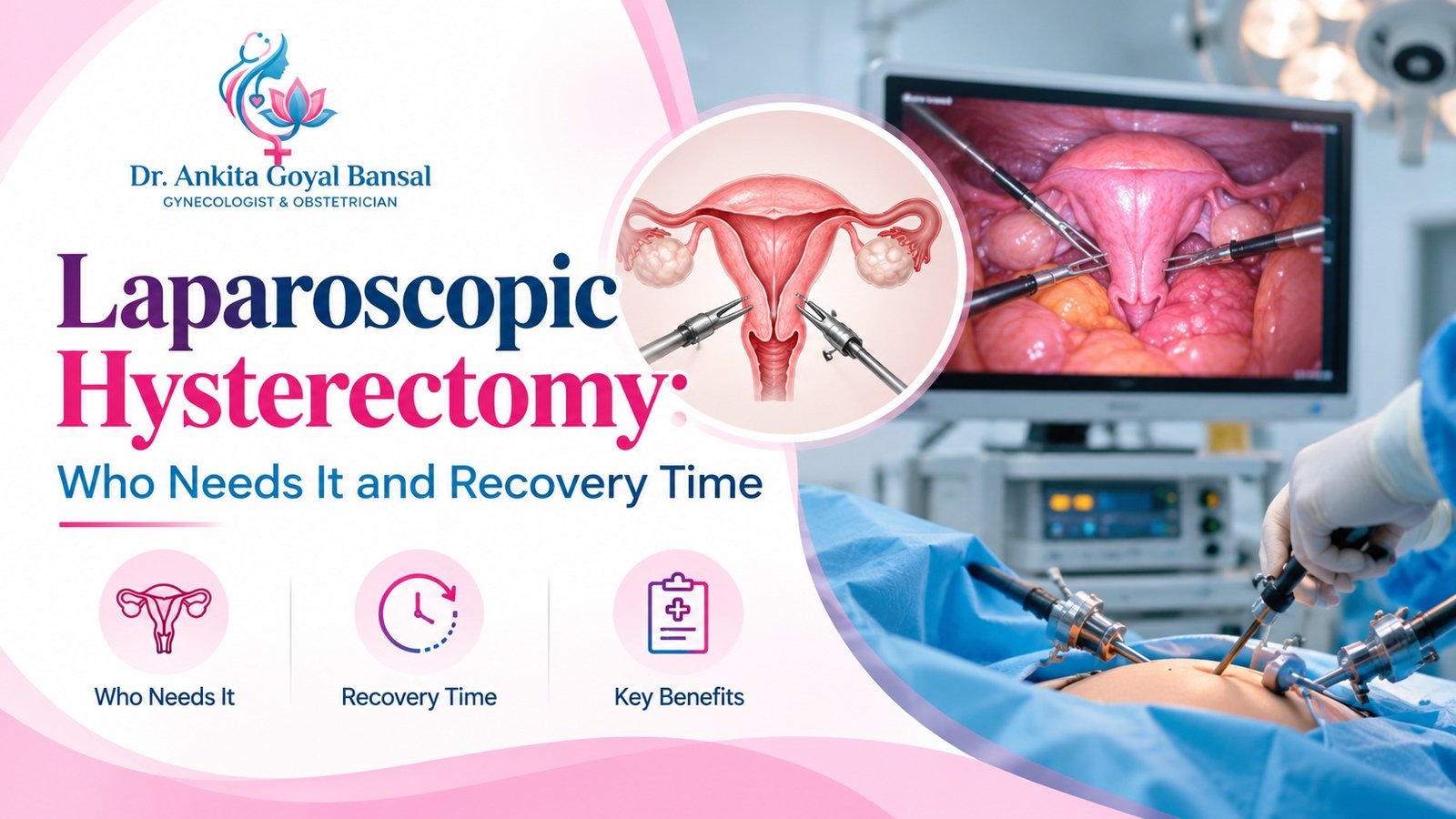
Hysterectomy is one of the most commonly performed operations in India, and also one of the most commonly performed without enough discussion first. It is the right answer for some women and an avoidable loss for others. This guide explains when it is genuinely needed, what alternatives exist, and what recovery actually looks like when it is done through keyhole incisions.
Quick answer: A hysterectomy removes the uterus, which ends periods and the ability to carry a pregnancy. It is genuinely needed for cancer, uncontrollable bleeding, severe prolapse, or symptoms that have not responded to other treatment. Done laparoscopically, most women go home in 24 to 48 hours, return to desk work at about two weeks and resume full activity at six weeks. Ovaries are usually kept if you are under 45. Call 096912 12570.
What a Hysterectomy Removes
A hysterectomy removes the uterus. Depending on the type, the cervix, fallopian tubes and ovaries may or may not be removed with it. Once the uterus is gone, periods stop permanently and pregnancy is no longer possible. The vagina, the ability to have intercourse and, in most cases, hormone production from the ovaries all continue as before.
It is a definitive operation. Fibroids cannot return, heavy bleeding ends and the risk of uterine cancer is removed. That finality is both its strength and the reason it deserves careful thought.
When It Is Genuinely Needed
- Cancer or pre-cancer of the uterus, cervix or ovaries, where it is the primary treatment
- Heavy bleeding that has not responded to medication, a hormonal intrauterine device or endometrial ablation, and is causing persistent anaemia
- Large or multiple fibroids with significant symptoms, in a woman who has completed her family
- Severe uterine prolapse where the uterus has descended and other measures have failed
- Adenomyosis causing severe pain and bleeding that medical treatment has not controlled
- Severe endometriosis after other treatments have been tried
- Life-threatening obstetric haemorrhage, as an emergency
Two situations deserve a second opinion as a matter of routine. First, if you still want children and a hysterectomy is proposed for a benign condition. Second, if the operation is advised for a fibroid or a cyst found incidentally on a scan, without symptoms. A diagnosis on a report is not by itself a reason to remove an organ.
Alternatives to Ask About First
| Option | Suitable For |
|---|---|
| Medication | Heavy bleeding, with tranexamic acid, anti-inflammatories or hormonal treatment |
| Hormonal intrauterine device | Heavy bleeding where the uterine cavity is not badly distorted; often very effective |
| Endometrial ablation | Heavy bleeding in a woman who has completed her family and does not want major surgery |
| Myomectomy | Fibroids, removing them while preserving the uterus, including for women who want children |
| Hysteroscopic removal | Polyps and submucosal fibroids inside the cavity, with no abdominal incision at all |
| Watchful waiting | Fibroids causing no symptoms, especially approaching menopause when they often shrink |
| Pelvic floor therapy or pessary | Mild to moderate prolapse |
None of these suit everyone. The point is that they exist and should be discussed before a hysterectomy is agreed for a benign condition.
Types of Hysterectomy Explained
By what is removed:
- Total hysterectomy: uterus and cervix. The most common.
- Subtotal or supracervical: uterus only, cervix left in place. Pap smears must continue.
- Hysterectomy with salpingo-oophorectomy: uterus plus tubes and ovaries.
- Radical hysterectomy: uterus, cervix, surrounding tissue and lymph nodes, for cancer.
By route:
- Total laparoscopic hysterectomy (TLH): through three or four incisions of 5 to 10 mm, with the uterus removed through the vagina. The preferred route for most benign cases.
- Vaginal hysterectomy: entirely through the vagina, with no abdominal incision. Excellent for prolapse.
- Abdominal hysterectomy: through a 10 to 15 cm cut. Still needed for a very large uterus, extensive adhesions or suspected cancer.
If abdominal surgery is proposed, it is reasonable to ask why a laparoscopic or vaginal route is not possible in your case, and our guide on finding a 3D laparoscopic surgeon sets out the questions to ask. Sometimes there is a sound reason. Sometimes the answer is simply what the surgeon is used to doing.
What Happens to Your Ovaries
This is the part patients are often not told clearly, and it matters more than the uterus for long-term health.
The ovaries produce oestrogen. If they are removed before natural menopause, you enter surgical menopause immediately, with hot flushes, sleep disturbance, mood changes, vaginal dryness and accelerated bone loss, all starting within days rather than gradually over years.
Current practice is to keep healthy ovaries in women under about 45 unless there is a specific reason to remove them, such as ovarian disease, severe endometriosis or a high genetic cancer risk. Removing the fallopian tubes while keeping the ovaries is increasingly standard, as it reduces ovarian cancer risk without causing menopause.
Ask explicitly: will my ovaries be removed, and if so, why? If the answer is only that it is routine, ask for the specific reason in your case.
Recovery Week by Week
| Timeline | What to Expect |
|---|---|
| Day 0 to 1 | Walking within hours, catheter removed, light diet; most patients discharged within 24 to 48 hours |
| Week 1 | Tiredness, mild wound soreness, shoulder tip pain from the gas; light vaginal bleeding is normal |
| Week 2 | Most women return to desk work and short drives; no lifting beyond a few kilograms |
| Weeks 3 to 4 | Energy improving noticeably, light household activity, gentle walking increased |
| Week 6 | Review appointment; usual clearance for intercourse, swimming, exercise and heavier lifting |
| Months 2 to 3 | Full energy returns; internal healing complete |
Report any of these promptly: fever, heavy or foul-smelling vaginal discharge, increasing wound pain or redness, calf pain or swelling, or difficulty passing urine. Light bleeding for up to six weeks is expected. Sudden heavy bleeding is not.
Life After a Hysterectomy
- Periods stop permanently. For many women with years of heavy bleeding, this is the main relief.
- No contraception needed. Pregnancy is no longer possible.
- Hormones continue if the ovaries were kept, and natural menopause arrives at the usual age, without periods to mark it.
- Intercourse is usually unchanged after six weeks of healing. Some women report improvement once pain and bleeding have gone.
- Pap smears are still needed if the cervix was left in place. Confirm which operation you had.
- Emotional response varies. Relief is common, so is a sense of loss, and sometimes both together. Neither is wrong, and it is worth saying so at your review rather than carrying it alone.
Questions to Ask Before Consenting
- Why is a hysterectomy necessary rather than a uterus-preserving option?
- Which alternatives have been considered, and why were they ruled out?
- Can it be done laparoscopically or vaginally rather than open?
- Will my ovaries be removed, and what is the specific reason?
- Will my cervix be removed, and do I still need Pap smears afterwards?
- How many of these do you perform in a year?
- What is the total cost in writing, and what is not included?
- How long before I can travel home and return to work?
Been Advised a Hysterectomy?
A second opinion costs one consultation and may reveal a uterus-preserving option. Dr. Ankita Bansal Goyal performs laparoscopic gynaecological surgery at Sankalp Hospital, Ambikapur. Monday to Saturday, 9:00 AM to 5:00 PM.
Book an Appointment →Frequently Asked Questions
1. How long does recovery take after a laparoscopic hysterectomy?
Most women go home in 24 to 48 hours, return to desk work at about two weeks and are cleared for full activity including intercourse and exercise at six weeks. Open surgery typically needs six to eight weeks.
2. Will I go into menopause after a hysterectomy?
Only if your ovaries are removed. If the ovaries are kept, they continue producing hormones and natural menopause arrives at the usual age. Periods stop either way, because the uterus is gone.
3. Should my ovaries be removed at the same time?
Usually not if you are under about 45 and the ovaries are healthy, because early surgical menopause carries real costs for bone and heart health. Removal is advised for ovarian disease, severe endometriosis or a high genetic cancer risk.
4. Can a hysterectomy be avoided for fibroids?
Often, yes. Medication, a hormonal intrauterine device, endometrial ablation, myomectomy and hysteroscopic removal all preserve the uterus. Fibroids without symptoms frequently need no treatment at all and shrink after menopause.
5. Will intercourse be affected?
Usually not after six weeks of healing. The vagina is unchanged in length for most women. Some report improvement once heavy bleeding and pain have resolved. Dryness is more likely if the ovaries were removed.
6. Do I still need Pap smears afterwards?
If the cervix was removed and the surgery was for a benign condition, routine Pap smears are generally not required. If the cervix was left in place, or the surgery was for cancer, screening continues. Confirm which operation you had.
7. How much bleeding is normal after the operation?
Light vaginal bleeding or brownish discharge for up to six weeks is expected as internal stitches dissolve. Sudden heavy bleeding, fever or foul-smelling discharge needs prompt medical attention.
8. Why do I have shoulder pain after keyhole surgery?
Carbon dioxide gas used to inflate the abdomen irritates the diaphragm, which shares a nerve supply with the shoulder. It is harmless, settles within a few days, and gentle walking helps the gas clear faster.