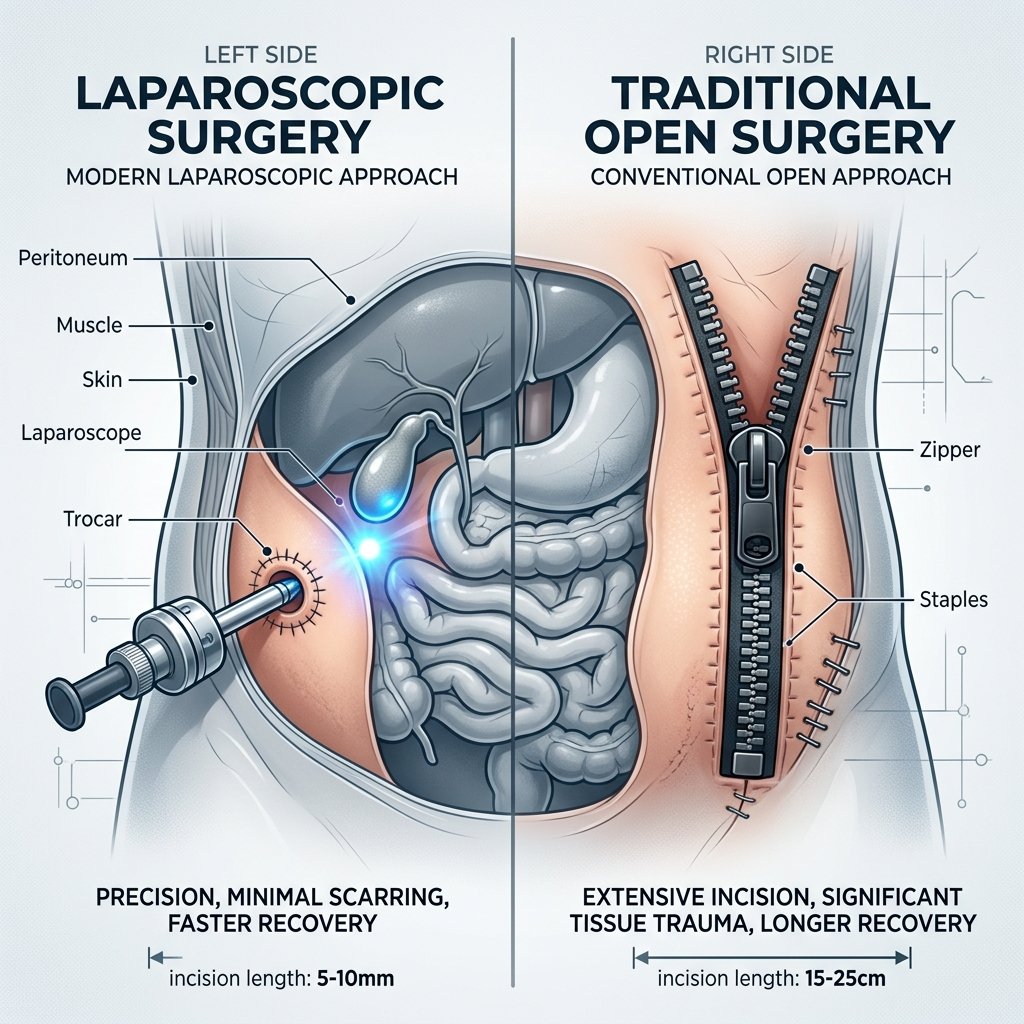
If you are facing an impending operation, one of the most critical decisions your medical team will discuss with you is the surgical approach: choosing between traditional open surgery and modern laparoscopy.
Understanding Both Methods
Open Surgery (Laparotomy): This is the traditional method. The surgeon makes a single, large incision (often 6 to 10 inches long) to gain complete, direct, hands-on access to the internal organs. This method creates a large wound that requires significant time to heal.
Laparoscopic Surgery: This advanced approach uses 3 to 4 tiny incisions. High-definition cameras and precision instruments are used. Some contemporary procedures even leverage advanced 3D laparoscopic surgery to provide unparalleled internal visuals without exposing the patient to the trauma of a major cut. It is an expert gynecological surgery approach widely favored today.
Detailed Comparison
- Incision Size & Scarring: Open surgery leaves a prominent scar, while laparoscopy leaves only tiny marks that often fade entirely.
- Hospital Stay: Patients undergoing an open procedure usually stay 3 to 5 days in the hospital. Laparoscopy patients often go home the same day or the next morning.
- Recovery Timeline: A laparotomy typically mandates 6 to 8 weeks for a complete recovery. With laparoscopy, patients generally return to desk work in 1 to 2 weeks.
- Pain Levels: Open surgery involves massive muscle separation, causing significant post-operative pain requiring potent analgesics. Laparoscopy creates minimal muscle trauma, leading to highly manageable pain.
When is Each Method Used?
Laparoscopy is overwhelmingly the first choice for routine and intermediate procedures. For example, for a standard laparoscopic ovarian cyst removal or specialized endometriosis care, open surgery is rarely necessary.
However, open surgery remains indispensable for colossal tumors, extensive widespread cancers, or severe surgical emergencies where immediate hands-on internal maneuverability is life-saving.
Unsure Which Surgery Type Suits You?
Let Dr. Ankita Bansal Goyal assess your unique case and determine the safest, least invasive way forward.
Book Your Consultation →Frequently Asked Questions
1. Is laparoscopy more expensive than open surgery?
Initially, laparoscopy can be slightly more expensive due to specialized equipment. However, because hospital stays are drastically shorter and recovery is faster, the overall cost and economic impact (less time off work) make it highly cost-effective.
2. Can a surgeon switch from laparoscopy to open surgery?
Yes. If severe bleeding occurs or the anatomy is obscured by dense scar tissue, a surgeon may confidently switch to an open procedure to ensure patient safety.
3. Are all surgeons trained in laparoscopy?
While most are exposed to it, advanced laparoscopic techniques—like minimally invasive fibroid treatment—require dedicated fellowship training and vast experience.
4. Does open surgery cure conditions better?
No. When performed correctly by skilled hands, Laparoscopy achieves the exact same surgical and curative goals as open surgery, simply via a different route.
5. Which approach has a lower risk of hernias?
Laparoscopy has a significantly lower risk of incisional hernia because the abdominal muscles are rarely cut or weakened on a large scale.
6. Will my prior open surgery prevent me from having laparoscopy?
Not necessarily, but prior open surgeries can cause internal scar tissue (adhesions). An experienced specialist will evaluate your specific history.
7. What happens to the gas used in laparoscopy?
The carbon dioxide used to inflate the abdomen is naturally absorbed into your bloodstream and exhaled safely through your lungs over 24-48 hours.