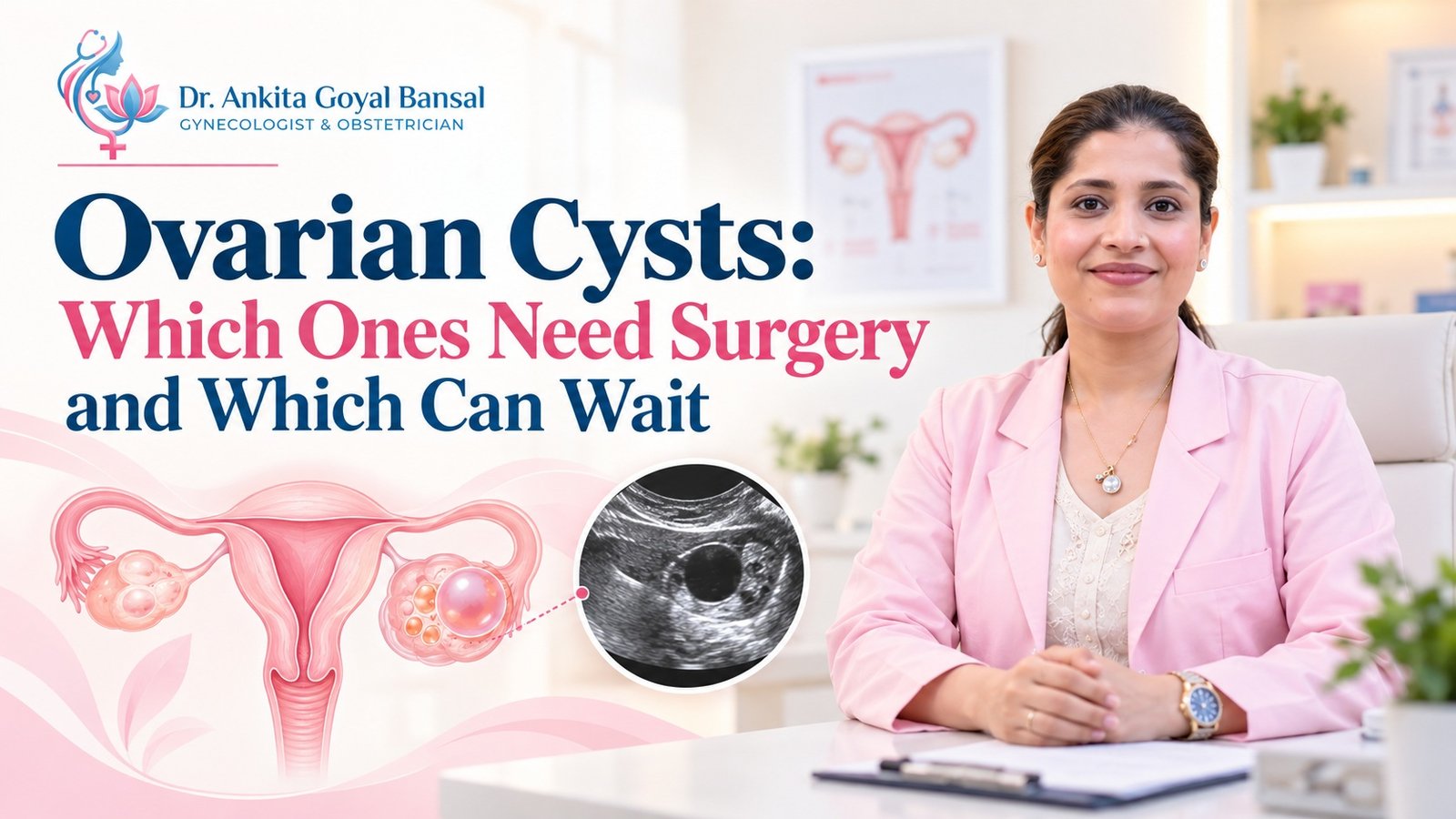
An ultrasound report mentioning an ovarian cyst causes immediate alarm in most women, and the word cyst does nothing to help. In reality the majority are a normal by-product of ovulation, they cause no symptoms, and they disappear within a few months without any treatment. A smaller group genuinely needs attention. This guide explains how to tell which is which.
Quick answer: Most ovarian cysts are functional, meaning they form as part of the normal cycle, and resolve on their own within two or three months. Surgery is considered when a cyst is larger than about 5 to 6 cm and persists, when it looks complex rather than simple on ultrasound, when it causes significant pain, or when it is a dermoid or endometriotic cyst. Sudden severe one-sided pelvic pain with vomiting is an emergency. Call 096912 12570.
What an Ovarian Cyst Actually Is
A cyst is a fluid-filled sac. Every month the ovary grows a follicle, a small fluid-filled structure containing an egg, which ruptures at ovulation. That is a cyst by definition, and it is entirely normal.
Problems arise when the process does not complete. If the follicle does not rupture, it keeps growing as a follicular cyst. If it ruptures and then seals and fills with fluid, it becomes a corpus luteum cyst. Both are called functional cysts, both are harmless, and both almost always disappear within two or three cycles.
Because this is tied to ovulation, functional cysts are common in women of reproductive age and uncommon after menopause. A cyst found after menopause is therefore taken more seriously, not because it is likely to be cancer, but because the usual harmless explanation no longer applies.
The Types and What Each Means
| Type | What It Is | Usual Approach |
|---|---|---|
| Functional | Follicular or corpus luteum cyst from the normal cycle | Repeat scan after 6 to 12 weeks; almost always resolves |
| Endometriotic (chocolate cyst) | Old blood from endometriosis collected in the ovary | Does not resolve; treatment depends on size, pain and fertility plans |
| Dermoid | A benign growth containing tissue such as hair, fat or teeth | Does not resolve; usually removed, especially above 5 cm |
| Cystadenoma | A benign growth from the ovarian surface, sometimes large | Usually removed if persistent or growing |
| Haemorrhagic | A functional cyst that has bled internally | Usually settles; repeat scan to confirm |
| Polycystic ovaries | Many small follicles, part of PCOS | Not cysts to be removed; PCOS is managed medically |
That last row matters, because the confusion is widespread. Polycystic ovaries are not a collection of cysts needing surgery. Surgery is not the treatment for PCOS.
Symptoms and Emergency Warning Signs
Most cysts cause nothing at all and are found incidentally. When symptoms do occur:
- A dull ache or heaviness on one side of the lower abdomen
- Bloating or a feeling of fullness
- Pain during intercourse, often on one side
- Pain around the middle of the cycle
- Changes in cycle pattern
- Needing to pass urine more often, from pressure on the bladder
Go to hospital immediately for sudden severe pain on one side, especially with nausea and vomiting. This can indicate ovarian torsion, where the ovary twists on its blood supply, or a ruptured cyst with internal bleeding. Torsion is a true emergency: the ovary can be saved if treated within hours, and is often lost if the delay runs into days.
How Cysts Are Assessed
- Pelvic ultrasound: the main test, usually transvaginal for a clearer view. It describes size, whether the cyst is simple or complex, and whether there are solid areas inside.
- Repeat ultrasound: after one to three months. This single step avoids a great deal of unnecessary surgery, since a functional cyst will simply have gone.
- Pregnancy test: always, in women of reproductive age, as an ectopic pregnancy can look similar.
- CA-125 and other markers: used selectively. CA-125 is often raised in endometriosis, fibroids and even during menstruation, so a mildly raised result in a young woman usually means very little.
- MRI: for complex or large cysts where ultrasound is not conclusive.
If surgery is being discussed, our guide on choosing a laparoscopic surgeon covers what to ask. The single most useful thing you can do is keep your old scan reports. A cyst that has been the same size for two years is a very different proposition from one that has doubled in six months.
Which Cysts Need Surgery
Surgery is generally considered when:
- The cyst persists beyond two or three cycles instead of resolving
- It is larger than about 5 to 6 cm, particularly if it is growing
- It looks complex on ultrasound, with solid areas, thick walls or internal divisions
- It is a dermoid or an endometriotic cyst, neither of which resolves on its own
- It causes significant pain or pressure symptoms
- There has been torsion or rupture
- It appears after menopause
- It is interfering with fertility treatment
Equally, surgery is usually not needed for a simple cyst under 5 cm with no symptoms, polycystic ovaries in PCOS, or a cyst that has not yet had a repeat scan. If an operation is proposed on a first scan showing a simple cyst, asking to repeat the scan in six to eight weeks first is entirely reasonable.
What the Operation Involves
The great majority of ovarian cyst operations are done laparoscopically, through three or four incisions of 5 to 10 mm.
Cystectomy removes the cyst while leaving the healthy ovary behind. This is the aim in almost all women of reproductive age. The cyst wall is carefully peeled away from normal ovarian tissue, which is exactly the kind of delicate work where 3D depth perception helps.
Oophorectomy removes the whole ovary, and is reserved for situations where the ovary cannot be salvaged, such as torsion with dead tissue, or where cancer is suspected. Even then, a woman with one healthy ovary continues to ovulate, menstruate and can usually conceive.
Recovery follows the usual keyhole pattern: home within 24 to 48 hours, desk work at about two weeks, full activity at around six weeks. The cyst is always sent for histopathology, with results usually available in about a week.
Cysts, Fertility and Your Ovary
Two concerns come up constantly in consultations.
Will surgery reduce my fertility? Removing the cyst while preserving the ovary has a small effect on ovarian reserve, because some normal tissue inevitably goes with the cyst wall. The effect is greatest with endometriotic cysts and with repeated operations on the same ovary. This is precisely why surgery should be done once, properly, by a surgeon who works carefully, rather than repeatedly.
Can I conceive with one ovary? Yes. The remaining ovary takes over and typically ovulates every month rather than alternating. Fertility is reduced only modestly.
If you are planning a pregnancy, say so clearly before surgery. It changes the surgical approach and how much tissue is preserved.
Scan Showing a Cyst?
Bring your reports and any previous scans for an honest assessment of whether surgery is needed at all. Dr. Ankita Bansal Goyal performs ovary-preserving laparoscopic cyst removal at Sankalp Hospital, Ambikapur. Monday to Saturday, 9:00 AM to 5:00 PM.
Book an Appointment →Frequently Asked Questions
1. What size ovarian cyst needs surgery?
There is no single number, but surgery is commonly considered above 5 to 6 cm, particularly if the cyst persists beyond two or three cycles or is growing. A simple cyst under 5 cm with no symptoms usually needs only a repeat scan.
2. Do ovarian cysts go away on their own?
Functional cysts, which are the most common type, usually resolve within two or three menstrual cycles. Dermoid cysts, endometriotic cysts and cystadenomas do not resolve and need a decision about treatment.
3. Are ovarian cysts cancerous?
The overwhelming majority are not, especially in women of reproductive age. Features that raise concern are solid areas on ultrasound, rapid growth, a cyst appearing after menopause, or fluid in the abdomen. These need prompt specialist assessment.
4. Will I lose my ovary?
Usually not. Cystectomy removes the cyst and preserves the ovary, and this is the aim in almost all women of reproductive age. The whole ovary is removed only when it cannot be salvaged, such as after torsion with dead tissue.
5. Can I get pregnant after ovarian cyst surgery?
Yes. Cystectomy preserves the ovary specifically for that reason. Even with one ovary removed, the other usually takes over and ovulates every month. Tell your surgeon before the operation if you are planning a pregnancy.
6. What is a chocolate cyst?
An endometriotic cyst, formed when endometriosis deposits inside the ovary bleed each cycle and the old blood collects. It is called a chocolate cyst because of the thick brown fluid inside. It does not resolve on its own.
7. Is a polycystic ovary the same as having ovarian cysts?
No. Polycystic ovaries show many small immature follicles, which are part of PCOS, a hormonal condition managed with lifestyle and medication. They are not cysts requiring removal, and surgery is not the treatment for PCOS.
8. When is sudden pelvic pain an emergency?
Sudden severe one-sided pain, especially with nausea and vomiting, can mean ovarian torsion or a ruptured cyst with internal bleeding. Go to hospital immediately. Torsion can often be reversed and the ovary saved if treated within hours.