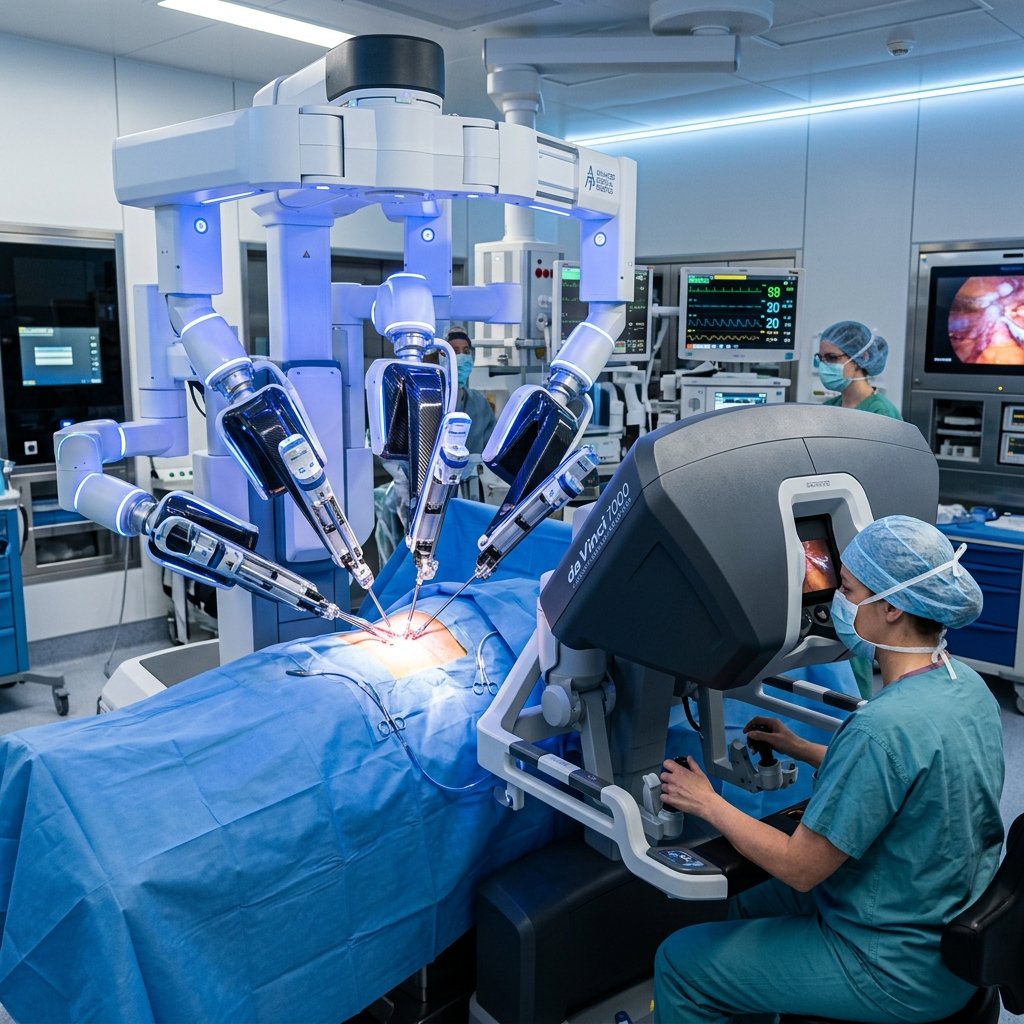
As surgical technology rapidly leaps forward, patients researching their options are frequently confronted with two extremely high-tech choices: traditional laparoscopy and robotic-assisted surgery. Let’s break down exactly what sets these two cutting-edge approaches apart.
Standard Laparoscopic Surgery
In standard laparoscopy, the surgeon stands physically beside the patient. They operate by holding specialized, long-handled instruments that have been inserted through tiny incisions in the patient’s abdomen. The surgeon relies on a high-definition monitor displaying a 2D or advanced 3D laparoscopic surgery feed to directly manipulate the tools with their own hands.
What is Robotic Surgery?
In a robotic procedure (such as the da Vinci system), the surgeon does not stand over the patient. Instead, they sit at a computer console located in the corner of the operating room. Using hand-and-foot controls, the surgeon acts as the "pilot," transmitting their exact hand movements seamlessly to robotic arms docked to the patient. These robotic arms hold the surgical instruments and move with incredible, tremor-free precision.
Key Differences Explained
- Range of Motion: Standard laparoscopic instruments move like chopsticks—they open and close, push and pull. Robotic arms possess "wrists" that rotate 360 degrees, mirroring the full dexterity of a human hand within the patient’s body.
- Visuals: While standard laparoscopy utilizes excellent high-definition cameras, robotic consoles fully immerse the surgeon in a true, highly magnified 3D binocular display.
- Physical Fatigue: For tremendously long operations, sitting comfortably at a robotic console reduces surgeon fatigue compared to standing bent over an operating table.
- The Cost: Robotic systems cost millions of dollars to purchase and maintain. Consequently, robotic surgery bills are considerably higher for patients and insurance companies than standard laparoscopy.
Which is Better for You?
For most routine operations like a laparoscopic ovarian cyst removal or straightforward minimally invasive fibroid treatment, a skilled laparoscopic expert provides fundamentally identical outcomes as a robot, making the higher cost of a robot unnecessary. However, for exceptionally radical surgeries or deeply infiltrating specialized endometriosis care requiring micro-dissections around vital nerves, the robotic "wrists" offer a distinct advantage.
Choosing the Right Surgical Path?
Empower yourself with precise knowledge. Schedule an advanced expert gynecological surgery consultation with Dr. Ankita Bansal Goyal to discuss which technology fits your condition best.
Discuss Your Options →Frequently Asked Questions
1. Does an actual robot perform the surgery autonomously?
No. "Robotic" is slightly misleading. The robot makes zero decisions and makes no automated movements. It is entirely a heavily advanced mechanical tool completely controlled by the surgeon at all times.
2. Are the surgical scars smaller with a robot?
Not necessarily. Both standard laparoscopy and robotic surgery are "minimally invasive," utilizing similar 5mm to 10mm keyhole incisions. The scars look virtually identical.
3. Does robotic surgery have a faster recovery than laparoscopy?
For most standard gynecological procedures, the recovery timelines (1 to 2 weeks for returning to work, less pain, fast hospital discharge) are exactly the same between both methods.
4. Is robotic surgery significantly more expensive?
Yes. The machinery and the disposable instruments connected to the arms are highly expensive, making the overall hospital bill visibly larger than standard laparoscopy.
5. Do all insurance plans cover robotic surgery?
Insurance covers the surgery if it is medically necessary, but some plans will only reimburse up to the cost of standard laparoscopy, forcing the patient to pay the "robotic premium" out of pocket.
6. What happens if the robot loses power?
Hospital operating rooms have instant, massive battery backups and dedicated generator power. Even in a catastrophic blackout scenario, the surgeon can manually undock the robot and complete the surgery laparoscopically or open.
7. Should I always demand the robot if it is available?
No. The skill of the surgeon matters far more than the tool. An incredibly experienced laparoscopic surgeon will yield far better results than a novice surgeon using a robotic machine.